Rigor. Smoke. Peer review at 225°F.
The Department of BBQ Sciences advances the study of slow-cooked meat through controlled fieldwork, longitudinal tasting and a refusal to wrap in foil before the stall has been properly observed.
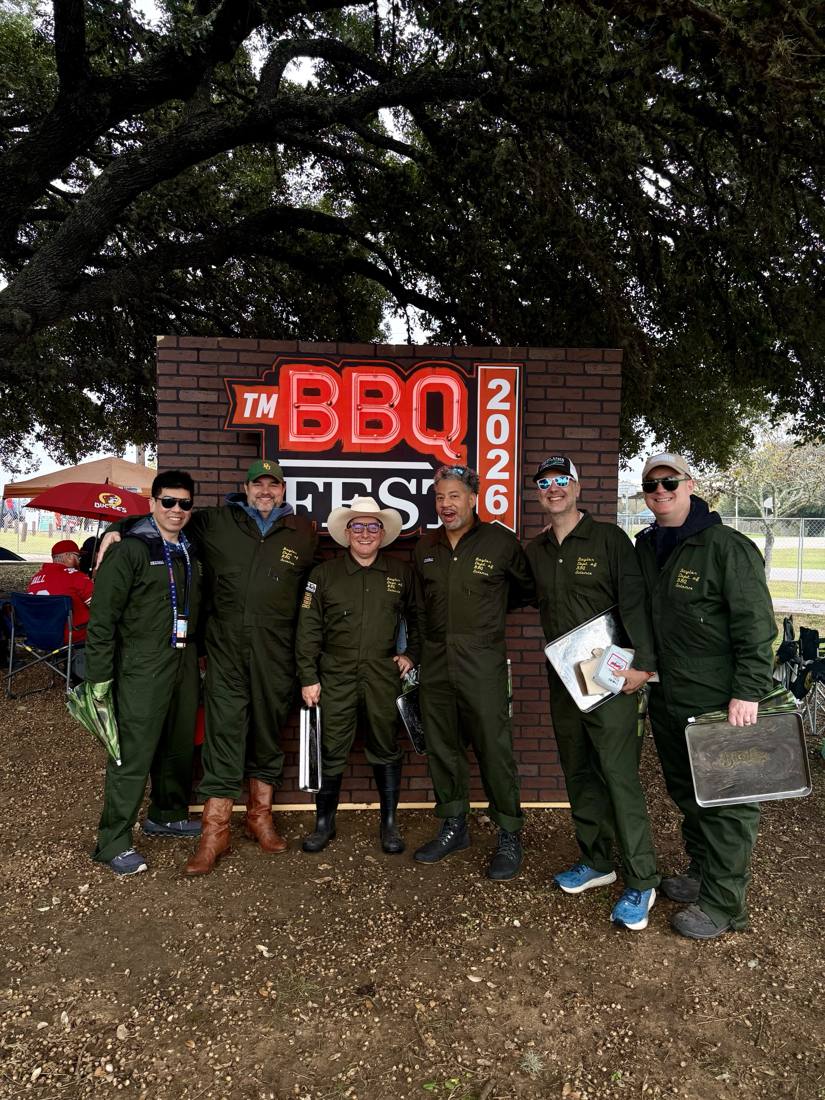
Why a department?
Texas barbecue has been studied informally for two centuries by people standing near a pit with a beer. The Department exists to make that study formal. We standardize the instruments (the tray, the butcher paper, the plastic fork), the sampling protocol (one of everything, then back for brisket) and the reporting (a group text that runs through Tuesday).
The Department was formed in 2011 by a group of Baylor Chambermen who disassociated from the Chamber to pursue the complete knowledge of barbecue. The first expedition was the inaugural Fest that year; after a long recess, the faculty has not missed one since 2023.
Areas of inquiry
Bark Formation & Adhesion
Maillard kinetics on the brisket flat, pepper-to-salt ratios, and the structural failure of bark under a dull knife.
Post Oak Combustion
Seasoning time, split geometry and the clean-fire problem. Mesquite is addressed in a single footnote.
Smoke Ring Metrology
Depth, color and the persistent myth that a thicker ring tastes like anything. Calipers issued to all students.
The Stall
Evaporative cooling between 150°F and 170°F and the psychology of the cook who panics during it.
Sauce Jurisprudence
Comparative law of Central Texas minimalism, East Texas sweetness and the Kansas City question. Sauce is served on the side.
Field Methods
Line strategy, tray carrying posture, and sharing protocol when the pitmaster hands over a burnt end unprompted.
The Annual Field Expedition
Each November the full faculty deploys to the Texas Monthly BBQ Fest to collect specimens from the state's top-ranked pits in a single day. Data are recorded on the departmental tray and reviewed on the ride home.
Expedition uniform: Class A green coveralls with gold thread, headgear at the discretion of the wearer, footwear suited to standing in a line for forty minutes on wet ground.
| Instrument | Spec | Status |
|---|---|---|
| Specimen tray, stainless | 13 × 18 in, half-sheet | Issued (6) |
| Field uniform, Class A | Coverall, olive, embroidered | Issued (6) |
| Instant-read thermometer | ±0.5°F | Rarely used |
| Umbrella | Compact | Weather-dependent |
| Sauce | — | Not issued |